
Custom Christmas props can give a brand event one recognizable seasonal shape: an oversized gift form, a sculptural outline or a dimensional campaign symbol. The useful starting point is the role of each piece. Decide what guests should notice and how the object relates to the brand before expanding the list of decorations.
For teams commissioning custom Christmas props in NYC or New Jersey, a reference photograph is only the beginning. The fabricator also needs to understand scale, visible surfaces, intended interaction and how the piece reaches its final position. These decisions help turn a seasonal idea into a defined scenic component.
Specify the individual piece and its purpose
List each proposed prop separately, with a reference number and a defined job. For a gift-shaped volume, specify whether it is a closed scenic object or a surround for a separately supported product. Record its depth, the faces visible to guests and whether the ribbon is a flat graphic or a dimensional detail. That distinction helps define the object before choosing its finish.
Separate an illustrative silhouette from an object guests are intended to handle or use. A gift-shaped scenic piece should not be treated as seating, a step or a product support unless that use has been explicitly evaluated and included in the design. Describe expected contact with the piece in the brief. Do the same for any products or separate decorations that will be attached to it.
Show scale from the important viewing positions
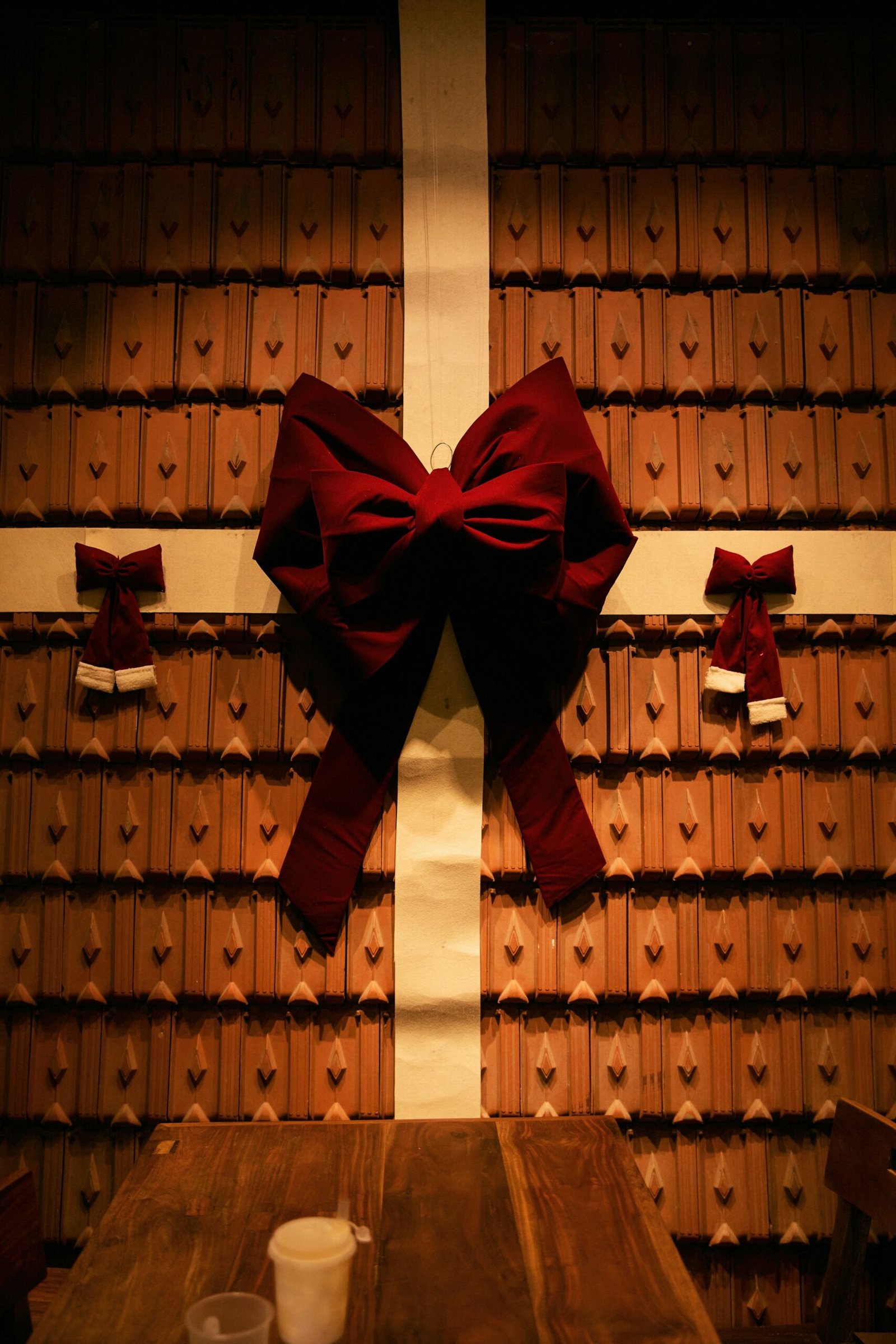
Write down height, width and depth, then show a person or product beside the proposed form. “Oversized” is a visual intention, not a usable dimension. A piece can look large in a close photograph and feel small across a room.
A flat tree or snowflake silhouette needs a defined front view and edge treatment. Show whether guests approach it head-on or see its back while moving through the room. Record whether it stands alone or belongs in front of another surface, plus its intended distance from nearby pieces. Those details distinguish a front-facing seasonal outline from an object that must read from several directions.
Check the relationship to neighboring pieces as well. Record whether a prop stands alone, sits beside a product display or forms part of a larger composition. The plan should show the intended gaps, rather than leaving the installer to interpret a collection of objects.
Describe what the material needs to accomplish
Instead of selecting a material from its name alone, describe the visual and physical requirements of the prop. Does it need a shaped opaque face, a transparent detail, a narrow outline or a combination? Which surfaces will guests see closely, and which parts connect to other components?
Arca’s wooden fabrication is a starting point for discussing shaped scenic forms and built surfaces. Its acrylic service provides a route for evaluating transparent or colored elements, while metal fabrication may be relevant to a proposed frame or outline. The appropriate combination needs to be evaluated against the actual dimensions and use.
For a ribbonlike curved form, show where the ribbon appears to turn, the visible face width and its depth. Identify the points where separate sections meet and whether guests can walk around it. Ask the fabricator to evaluate the form and connections; a flowing reference image alone does not define how the scenic piece is assembled.
Approve the finish at the level guests will see
A color reference does not describe an entire finish. Note the desired surface appearance, visible edges and any contrast between the main form and its details. If the prop includes campaign graphics, provide the approved artwork and specify the faces on which it belongs.
Review the main face, returns, top and rear according to their visibility. A freestanding object near an entrance may be seen from more directions than a piece placed against a wall. Mark those conditions on the drawing rather than assuming the back is hidden.
Ask how the finish will be reviewed before fabrication proceeds. If another vendor provides event lighting, share finish references with that team and coordinate the intended view. Keep the object, applied graphics and separately supplied decorative elements identifiable in the approval record.
Define handling and installation interfaces
Prop dimensions and delivery conditions belong in the same discussion. Provide the venue location, receiving route and final placement. If a piece needs to arrive in sections, ask how the assembly relates to visible seams and whether finishing work is part of the agreed on-site scope.
Assign responsibility for the handoffs around each object:
- Graphics: who supplies approved files and who incorporates the finished graphics.
- Added elements: who supplies them, with dimensions and attachment requirements.
- Placement: who confirms the final position and the venue’s relevant requirements.
- Event close: who removes the piece and the agreed destination afterward.
Keep these interfaces specific to the prop rather than copying a generic event scope. The event fabrication brief guide can help organize the information. If costs need comparison, use the fabrication cost guide to check which tasks each proposal includes. Availability and installation scope must be confirmed for the actual project.
Frequently asked questions
What should we send for an oversized holiday prop?
Send dimensions, reference images, intended use, venue information and a view showing the object beside a person or product. Note which faces will be visible and whether guests are expected to touch it.
Can a Christmas prop use more than one material?
Discuss the desired effect and connections with the fabricator. Mixed materials may suit different parts of a concept, but the combination needs evaluation for that piece. Identify the visual transitions in the approval.
Can a scenic gift box hold products or support a person?
Do not assume a scenic shape is designed for either use. State the intended loads and interaction before requesting a proposal so the fabricator can evaluate what the scope requires.
Discuss custom holiday props with Arca
Bring a defined seasonal object to Arca’s creative production and scenic fabrication team. Send the event date, NYC or NJ location, approximate dimensions, visual references and working budget. Include a numbered list of pieces and their intended uses so the conversation can focus on the forms and fabrication details your campaign needs.
Cover Photo: Following NYC / Pexels. Illustrative reference for the visual scale of oversized Christmas props; not an Arca project.
Arca Studio Creations
Have a structure in mind?
We design, engineer and fabricate custom structures for luxury events across New York and New Jersey.
Contact us


