
A useful event fabrication brief tells a builder what the installation must do, what it should look like, where it must fit, and what the project includes. Start with the event date, venue, deliverables, dimensions, reference images, budget range, and approval contact. Mark anything unconfirmed so it becomes a question to resolve before fabrication.
For planners, agencies, and venues, the brief connects a creative idea to decisions that can be priced and built. It also makes proposals easier to compare: two quotes are only comparable when they cover the same work. Use the following structure for a custom backdrop, branded display, scenic environment, or other event build in New York or New Jersey.
Start with the job the installation needs to do
Describe the guest interaction before choosing materials. Will guests pose in front of it, walk through it, approach a counter, or view it from across a room? Will staff need hidden storage or access behind the set? Note whether the piece is indoors or outdoors and whether it is intended for one event or repeated use.
A useful objective might be: “Create a branded photo area that works for small groups, with a clear approach from the entrance and no visible service storage.” That gives the team more direction than “Make a memorable backdrop.” Identify what success looks like from the guest's viewpoint and from the planner's operational viewpoint.
Separate visual references from approved requirements
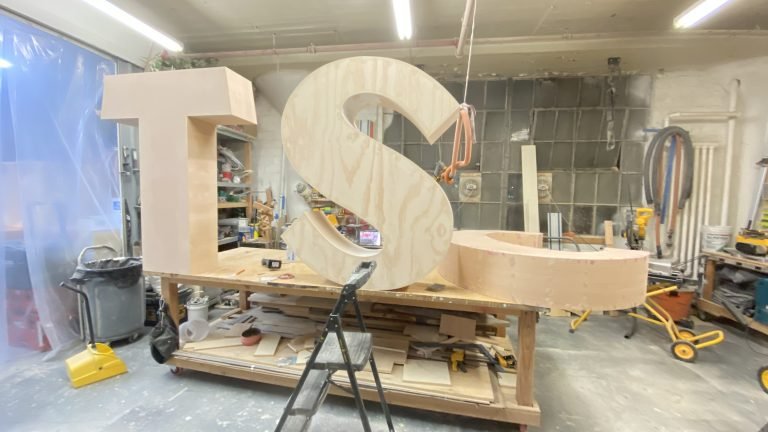
Attach a small, edited set of references and explain what each contributes. One image may show the silhouette, another the surface finish, and another the desired lighting effect. State which details are essential and which are open to interpretation. A reference image alone does not establish the material, scale, construction method, or budget.
Provide a dimensioned plan or sketch where available. Label each measurement as approved, approximate, or awaiting a site check. Distinguish the overall footprint from usable space, and flag adjacent doors, furniture, equipment, or guest circulation that may constrain the design.
For branded elements, include approved artwork files, color references, logo placement, and the person who signs off on proofs. Keep an approval record tied to the current drawing version. “Approved visually” should not accidentally become “all dimensions and site conditions confirmed.”
Define the scope on both sides of the handoff
List each deliverable separately, including its quantity and finish expectations. State what the fabricator is being asked to supply and what another vendor will provide. Graphics, lighting, floral elements, AV, power, transport, installation, and removal need explicit owners when they form part of the concept.
For example, a screen opening affects fabrication even if an AV company supplies the screen. The brief should identify who confirms the equipment dimensions, provides mounting information, and coordinates service access. Ownership of the screen does not automatically assign responsibility for every interface around it.
Include access information early: the receiving location, loading arrangements, route to the event space, freight elevator details if relevant, and installation and removal windows. If those details are pending, name the venue contact who can confirm them. Access constraints can change how a piece is divided, transported, and assembled.
Use our event load-in checklist to organize the route, receiving arrangements, and installation sequence.
Give the budget context needed for useful options
Share the working budget range and say what it must cover. A fabrication allowance that excludes transport and installation means something different from a total production budget. Identify any separately contracted services so the estimate does not silently omit them or count them twice.
Then rank your priorities. Perhaps the shape and camera-facing finish are fixed, while the rear finish is flexible. Perhaps reusability matters more than a seamless surface. These priorities help the team propose alternatives with a clear reason behind them.
Pricing can vary with size, quantity, material, finish complexity, graphics, access, assembly, packing, transport, and the scope of installation and removal. Design changes after an agreed approval point can also affect cost and scheduling. Ask which assumptions drive the estimate instead of treating a single total as a complete explanation.
Copy this event fabrication brief template
Fill in the fields below. “To be confirmed” is a useful answer when it includes an owner and a decision date. These are working fields for your project, not information that must be invented before the first conversation.
- Project and contact: Event name; organization; day-to-day contact; final decision-maker.
- Purpose: Guest interaction; operational needs; what a successful installation must achieve.
- Location and dates: Venue and room; event date; installation access; removal access.
- Deliverables: Item names; quantities; intended use; indoor or outdoor setting; reuse plans.
- Dimensions: Overall size; footprint; critical clearances; measurement status; attached drawing version.
- Creative direction: Reference images with notes; essential features; flexible features; artwork files.
- Finish expectations: Visible faces; texture and color references; sample or proof approvals needed.
- Interfaces: Graphics, AV, lighting, floral, power, and other vendor contributions; owner for each connection.
- Access: Receiving point; route; elevator or doorway information; venue restrictions; items still awaiting confirmation.
- Budget and scope: Working range; included services; separately contracted services; priorities for alternatives.
- Approvals: Who approves design, dimensions, artwork, and changes; target decision dates; current open questions.
- After the event: Removal owner; return, storage, reuse, or disposal instructions; destination of retained pieces.
Keep the brief and its attachments together. Use clear filenames and a revision date so an updated floor plan does not get separated from the request. When something changes, state the specific change and ask whether it affects the current proposal.
Ask for a quote that makes assumptions visible
A conceptual brief starts the discussion; it is not necessarily a construction-ready package. Likewise, an early budget estimate may depend on measurements, material selections, or venue information that have not yet been confirmed. Ask the fabricator to identify that status explicitly.
When requesting an event fabrication quote, ask for the deliverables and quantities, material and finish assumptions, included services, exclusions, and items awaiting confirmation. Also request the approval milestones, payment terms, quote validity, and how later changes will be documented and priced.
Compare scope before comparing totals. If one proposal includes installation and another ends at delivery, resolve that difference first. If a finish is described only as “painted,” ask which faces are included and how the color or appearance will be approved. Clear questions at this stage reduce ambiguity during production.
A hypothetical brief improvement
Imagine an agency requests “a white branded wall like the attached photo” for an NYC launch. The venue uses a freight elevator, but the agency has only supplied the assembled wall size.
A better brief adds the required guest interaction, approved wall dimensions, visible-face finish, logo artwork owner, and delivery scope. It marks the elevator route as awaiting confirmation by the venue. The fabricator can then discuss transportable sections and proposed seam locations before the visual design is approved. The brief has turned an attractive image into a set of answerable production questions.
Bring the brief to a fabrication conversation
Arca Studio Creations works with event planners, agencies, production houses, and venues across New York, New Jersey, and the Tri-State area. Its production services provide a starting point for discussing a concept and its fabrication needs.
Review Arca's work to identify visual directions you want to discuss, then send your project brief with the event date, venue, references, approximate scope, and working budget. Include open access or measurement questions so the conversation can focus on what needs to be resolved next.
Arca Studio Creations
Have a structure in mind?
We design, engineer and fabricate custom structures for luxury events across New York and New Jersey.
Contact us


